


Hiring a digital marketing specialist is one of the highest-leverage decisions a small business can make.
Done right, it can triple your leads, scale your revenue, and free you from the time-consuming, constantly-changing world of digital channels.
Done wrong, it’s an expensive lesson in why ‘we handle everything’ promises rarely mean what they sound like.
I’ve had hundreds of conversations with business owners who came to me after a bad experience with a previous marketing provider.
The same patterns come up again and again: vague promises, vanity metrics, work done by inexperienced subcontractors, and a contract that made it difficult to leave.
They lost time.
They lost money.
And they lost confidence in digital marketing altogether.
This guide will walk you through how to choose a digital marketing specialist, including what to look for, what questions to ask, and the red flags to avoid before hiring.
The right digital marketing specialist doesn’t just do the work; they become a genuine growth partner for your business. Know how to tell the difference before you sign anything.
- Specialist vs Generalist: Why It Matters More Than You Think
- The 7 Questions to Ask Any Candidate
- Red Flags to Walk Away From
- What a Strong Engagement Actually Looks Like
- Freelancer vs Agency vs Specialist: A Quick Comparison
- Making the Final Decision: How to Choose a Digital Marketing Specialist
- Conclusion
Specialist vs Generalist: Why It Matters More Than You Think
The digital marketing industry is full of generalists who claim to do everything. Social media, SEO, Google Ads, Shopify, email marketing, branding…
…the list is long and the experience behind it is often shallow.
There’s nothing wrong with a generalist at the right stage of a business.
If you’re brand new and need someone to set everything up from scratch, a generalist can be a good starting point. But if you’re past the basics and need results in a specific area, a specialist is almost always the better investment.
A true specialist has deep expertise in a defined area or a complementary cluster of services and a track record of measurable results in that area specifically.
They’ve seen enough of the same type of problems to know what works, what doesn’t, and what to test when a strategy isn’t landing.
How to test for depth:
Ask any marketing provider:
‘What is your deepest area of expertise, and can you show me results specifically from that area?’
Their answer will tell you everything.
A generalist will give you a broad answer.
A specialist will get specific — specific platforms, specific industries, specific outcomes.
Look for someone whose experience aligns with your actual goal.
If you want more leads from Google, you want someone who has run SEO or Google Ads campaigns, not someone who’s dabbled in it alongside 12 other services.
The 7 Questions to Ask Any Candidate
Before committing to any marketing provider, ask these seven questions.
Pay attention to both the content of their answers and how they deliver them. A good specialist will give you specific, confident, evidence-backed responses. Vague answers are a warning sign.
- Ask for metrics, not just case study names. ‘We helped a retail client grow their revenue’ is not an answer. ‘2.3x ROAS on Meta Ads for a beauty eCommerce brand over 90 days’ is.
What specific results have you achieved for businesses similar to mine? - Look for revenue-tied KPIs (sales, leads, bookings, cost per acquisition). Be cautious of anyone who leads with vanity metrics like follower counts or impressions.
How do you measure success, and what does your reporting look like? - Agencies often pitch senior talent and deliver junior execution. Ask directly: ‘Will you personally be managing my account, or will it be handed off to a team member?’ Know exactly who is running your campaigns.
Who will actually be doing the work? - A good specialist has a structured onboarding, an audit phase, a strategy document, a clear plan. ‘We’ll get started immediately’ is not a process.
What’s your process in the first 30 days? - This is one of the most revealing questions you can ask. Look for a clear process: ‘We review performance weekly, identify the underperforming variable, pause it, and test an alternative hypothesis.’
What you don’t want is a vague reassurance that they’ll ‘sort it out.’ What happens when a campaign isn’t performing? - Relevant experience shortens the learning curve and reduces your risk. A specialist who has worked with similar businesses will already understand your audience, your competitive landscape, and the creative approaches that tend to work.
Can you show me examples of work in my specific industry or market? - The best specialists ask as much as they’re asked. A good marketing engagement is a two-way partnership. If they claim to need nothing from you, be skeptical, strong results almost always require some input from the business owner.
What do you need from me to be successful?
Pro tip: The quality of their questions tells you as much as the quality of their answers. A great specialist is as curious about your business as you are about their track record.
Red Flags to Walk Away From
Knowing what not to accept is just as important as knowing what to look for. These are the most common red flags I see and why each one matters.
- No one can guarantee search rankings, specific ROAS targets, or follower growth.
Algorithm changes, market shifts, and competitive dynamics are outside anyone’s control.
If someone is guaranteeing outcomes, they’re either overselling or planning to game the system in ways that can damage your brand. Guaranteed results. - A professional will define exactly what’s included in your investment: deliverables, number of campaigns, reporting frequency, platform coverage. ‘
We’ll do what it takes’ sounds flexible; in practice, it usually means unclear expectations and scope creep. Vague pricing with no defined scope. - Your Google Ads account, Meta Business Manager, Google Analytics, and Google Business Profile belong to you.
Any provider who wants to hold those under their own account — rather than granting you full ownership — should be a non-starter.
If you leave, you should take your assets with you. No access to your own accounts. - Legitimate specialists earn your continued business through results.
A 12-month lock-in with no performance benchmarks protects the provider, not you. Look for rolling monthly arrangements or contracts with clear milestones and exit clauses.
Long lock-in contracts without performance milestones. - If their monthly report focuses entirely on reach, impressions, and follower growth without connecting those to revenue or leads, the reporting isn’t designed to hold them accountable, it’s designed to look impressive.
Reporting that doesn’t connect to business outcomes. - Jargon is sometimes necessary, but a good specialist can always translate their work into business terms you can understand.
If they can’t explain why they’re recommending a strategy and what outcome it’s designed to produce, that’s a problem. They can’t explain what they do in plain language.
What a Strong Engagement Actually Looks Like
Having worked with clients across the UK, Australia, the US, and Southeast Asia, I’ve seen what a well-run marketing engagement looks like and what it produces.
Check my services and learn more what to expect from the right partnership.
In the first 30 days:
- A thorough audit of your current marketing — your website, your existing channels, your analytics data — before any recommendations are made
- A written strategy document that ties proposed activity to your specific goals and budget
- Clear onboarding: access to accounts, brand assets, and any background materials you can share
- An agreed-upon reporting cadence so you always know what’s happening without having to chase
Ongoing:
- Proactive communication — you shouldn’t need to ask for updates. A good specialist keeps you informed, flags issues early, and presents solutions alongside problems.
- Honest performance reviews — if something isn’t working, they tell you, explain why, and pivot with a clear rationale.
- Reporting in language you can understand — not just dashboards, but commentary that connects the numbers to your business.
- A relationship that evolves — as your business grows, the strategy should grow with it.
Freelancer vs Agency vs Specialist: A Quick Comparison
Not all marketing providers work the same way.
Some businesses need affordable task-based support, while others need a full team or a highly focused expert who can drive measurable growth.
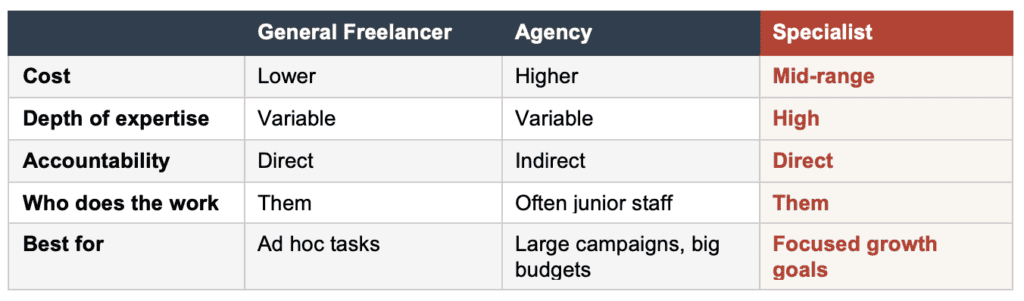
To help you understand the differences, here’s a quick comparison of freelancers, agencies, and specialists based on cost, expertise, accountability, and overall business fit.
Not sure where to start your search?
Different platforms attract different types of professionals. Some are better for affordable freelance support, while others are ideal for finding established agencies or experienced specialists with proven results.
Here are some of the most common places businesses look when hiring marketing support.
| Platform | Best For | Link / Suggestion |
|---|---|---|
| Freelancer | Small tasks, short-term support, budget-friendly work | Upwork, Fiverr, OnlineJobs.ph, Facebook groups, LinkedIn |
| Agency | Full-service marketing, large campaigns, multi-channel management | Clutch, Google search (“digital marketing agency near me”), LinkedIn |
| Specialist | Focused expertise, strategy, performance marketing, SEO, Google Ads | LinkedIn, Google Partner Directory, personal portfolio websites, industry referrals |
Making the Final Decision: How to Choose a Digital Marketing Specialist
Once you’ve had initial conversations and reviewed their work, use this three-part framework to make your final call.
1. Do their results match your goal?
Don’t just look at their best case study.
Look for a case study that’s relevant to what you’re trying to achieve.
If you want more foot traffic for a local service business, find out if they’ve done that before. If you want to scale a Shopify store, ask for an eCommerce example.
2. Does their communication style suit you?
You’ll be working with this person closely. If their initial communication is slow, unclear, or generic, it’s a preview of what working together will feel like.
Trust your read on this.
3. Does the scope match your budget, honestly?
Cheap is rarely good value in digital marketing. But expensive doesn’t automatically mean better.
Look for a provider who is transparent about what your budget can realistically achieve and who would rather set accurate expectations than overpromise and underdeliver.
Conclusion
The right digital marketing specialist is not just a service provider, they’re a growth partner. The criteria in this guide exist because I’ve seen the alternative: businesses that invested in the wrong fit, lost months of momentum, and then had to start over.
Take your time. Ask the hard questions. Trust the patterns in their track record, their communication, and their willingness to be held accountable.
If you’re evaluating your options and want a direct, no-pressure conversation about whether I’m the right fit for your business, I’d love to hear about what you’re trying to build.
Ready to talk to a specialist who leads with results not promises?
Book your free 30-minute strategy call!